Showing posts with label history of Moscow. Show all posts

Thursday, May 16, 2013

Victory Day in Russia

On the 9th of May whole Russia celebrated its most significant holiday - the Victory Day - established due to the great victory in 1945.
During the long years of the war Russia experienced a lot, millions of people were killed...

This Day is a special Day for everyone.
How do the Russians celebrate it?

Almost every state organises a parade - mostly military technique is demonstrated.
Naturally, the most important parade is at red Square in Moscow. The President and all the civil servants are present there. Moreover, veterans, honoured heroes of the war, are present there and receive congratulations and enjoy this great for them holiday. However, almost every big park of Moscow becomes a place for celebrations (Park Gorkogo, Park Pobedi)

After it some veterans go to the Theatre Square, near Bolschoy Theatre, where festive, sincere atmosphere is set...You may here military songs and see dance.. A lot of people gather here, most of them are young, they come to congratulate veterans with their holiday and say "THANK YOU"...

In Russia there is a song "Victory Day" with the lines "Victory Day is the holiday with tears on your eyes..."
Yes, indeed, hardly no one can hold back their tear when then they hear military stories...

The day end with bright fireworks. People usually shout out loud "Ура!" (Ura!) which means "Hooray!"

Sunday, March 31, 2013

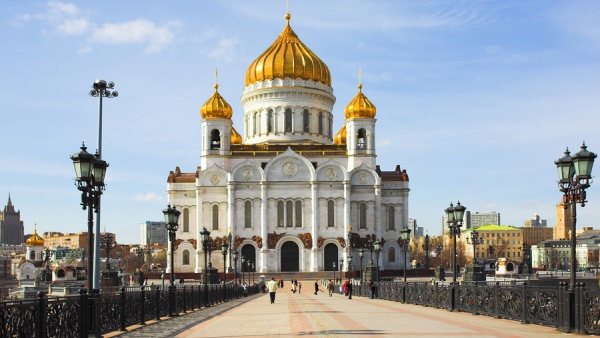
Cathedral of Christ the Saviour

The Cathedral  in front of Kropotkinskaya is Russian main orthodox church.
It is placed on the bank of Moskva-river so that its grand golden dome may be seen from everywhere.

The history of the cathedral deserves special mention.
In 1832 its first project was confirmed by architect Konstantin Ton. It took about 40 years to build this church, which was to honour the war of 1812 between Russia and France.
Unfortunately, it was detonated in 1931. Soon a new swimming-pool appeared at that place.
Only in the 80s the government decided to restore the temple. Five years later the construction was over. Only in 2000 it was hallowed.

The height of the cathedral is 102m, the width - 85 m. It can seat 10,000 people at a time.
What is interesting, is that that the gold cupolas resemble an onion which in their turn look like helmets of great Russian epic heroes - Bogatir.

Tourist may visit the cathedral, order excursions, enjoy a marvellous sight of Moscow from the cathedral's observation deck.

Address: Volkhonka St, 15
It works daily 10.00-17.00. On Fridays 13.00-17.00
Official website: http://www.xxc.ru/english/index.htm


"Bogatiri" by V. Vasnetsov, 1898


Monday, March 4, 2013

Moscow Metro. Park Kultury VS Kropotkinskaya

To reach Ostozhenka you may choose any metro station either Park Kultury or Kropotkinskaya.
We've chosen Park Kultury.

Park Kultury was opened in 1935 as a station of the first metro line (Sokolnicheskaya). It was named after the park which is situated near this metro station and has the same name. To find that park you should cross the bridge over Moskva-river. (about that Park we'll speak later))
The metro station has, so to say, two stations - the 1st one is on the red line, the 2nd - on the brown ring (was opened in 1950). (Circle line, or Koltsevaya).

Park Kultury.Circle line.

Red line

Kropotkinskaya station was also opened in 1935 as one of the 1st metro stations, it is next to Park Kultury.
There is also much to explore around it : Gogolevsky Boulevard which goes to Arbat, in front of the metro is the famous Cathedral of Christ the Saviour, near it the Pushkin Museum. 


Kropotkinskaya station. Entrance.


Kropotkinskaya station. Hall.

Sunday, March 3, 2013

Ostozhenka Architecture. Part 2.

Behind the office of the military attache we can see the top of the nunnery, founded in 1584. Though it is sad to say, but once it also used to be a prison and a colony.
Use Korobeynikov lane (Коробейников переулок) or 1st Zachatjevskiy lane (Зачатьевский переулок) to reach it.


This house built in 1907-1909 is famous as a "house with a wine glass". Once belonged to merchant Filatov who used to be addicted to alcohol. When he suddenly gave up drinking and became successful, he decided to build a house with a turned wine glass on its roof as a sign of the protest against drinking.


Ostozhenka is a marvellous place to walk on a sunny day and enjoy different styles of architecture. Turn to its side streets and you'll see yet another world. 


Ostozhenka Architecture. Part 1.

This street is very famous among tourists for its unusual architecture. As is known merchants who lived here tried to make their houses as unique as possible. Fortunately, all these buildings (or most of them) have "survived" and now people of the XXI century have a possibility to see the result of the architects' grand imagination.

1) Moscow State Linguistic University has a long history: was built in the 60-70th of the XVIII for D.Eropkin, one of the famous activists of that time.


2) This house belonged to S. Turgenev's mother. He was one of the greatest Russian writers.
People believe that it was in this house that he wrote his famous novel "Mumu" (the name of the dog which destiny is described there).Now it is a museum.


3) This building  which is now the office of the military attache of Egypt used to be a house for architect Kekushev's wife, was built in 1902-1903.

Monday, February 11, 2013

Brief History of Moscow


Moscow is the capital of the Russian Federation.
Does anybody know how many times it got and lost this status? How old is Moscow?

It is universally recognized that the first record of Moscow dates back from 1147. Russian prince from the Rurik Dynasty Yuri Dolgorukiy is considered to be the founder of Moscow. Dolgorukiy means the Long-Armed as he managed to acquire vast territories which then made Kievan Rus' with the political center in Kiev.

Moscow has a long and complicated history with many difficulties and invasions. Many times it was under the threat of being conquered, many times it was rebuilt... But still it proved to be a strong city.

Only in the 15th century Ivan the Great (Ivan III) made Moscow the capital of all Rus. This Grand Prince of Moscow is known as the gatherer of the Russian lands as he managed to unite all the Russian principalities under one authority and save Rus from the Golden Horde which had been dominated Rus for more than one century.

Till the 18th century Moscow was a political center of Russia under Ivan IV the Terrible and his successors. The time of the 16th century is to be one of the hardest for the city. Moscow experienced the Times of Troubles and then the establishment of the new dynasty - the Romanovs.

Under Peter the Great Moscow lost its status of the capital of the Russian Empire. In 1712 Saint-Petersburg acquired this status, however, Moscow still remained a spiritual and cultural center. For example, Moscow State University was founded in this city in 1755 under Elizaveta Petrovna, the Empress of Russia, Peter's daughter.

1812 is a memorable day for Moscow. During this year the Moscovites courageously fought against the Frenchmen led by Napoleon. After long exhaustive battles Moscow was free. In 2012 a big fest was held in Moscow - 200 Years of the Battle of Borodino, the most difficult fight with the French armies.

A century later, in 1918, Moscow became the capital, but not of the Empire, but of the The Russian Soviet Federative Socialist Republic, and later of the Union of Soviet Socialist Republics. Moscow developed in every field: transport system, architecture, culture, science...

After the Great Patriotic War Moscow is recognised as one of the Hero Cities of Russia which fearlessly defended themselves.

Since 1991 Moscow is the capital of the Russian Federation and along with Saint-Petersburg is a federal city.