Showing posts with label Moscow architecture. Show all posts

Thursday, April 18, 2013

Pushkin Museum

One of the great Russian world-known writers and poets is Aleksandr Pushkin (1799 -1837).

Moscow provides a few museums named after A. Pushkin, however, even not all the citizens of the city are aware of them.
The biggest and the most famous is the Pushkin State Museum of Fine Arts.
Even the building of the museum itself is worthy seeing as it is decorated with beautiful columns and statues of ancient heroes or philosophers.
The museum exhibits impressive collections of statues, figures which reflect culture of ancient cultures. Besides, there are a number of halls devoted to paintings of various artists.
The museum holds different exclusive exhibitions. For example, last year work by Salvador Dali were exhibited there.

Address: m. Kropotkiskaya, Volkhonka St 12,
Opening Hours: daily from 10 am to 7 pm. Closed on Monday.
Official website: http://www.arts-museum.ru/index.php?lang=en

Another museum named after Pushkin is also situated near the metro station Kropotkinskaya, but on the opposite side.

Pushkin State museum 
The museums provides with regular exhibitions "Pushkin and his Epoch", "Pushkin's fairy tales", There are a few concert and confereтсу halls where various events take place.

Address: m. Kropotkinskaya, Street Prechistenka 12/2
Opening hours: daily from 10am to 6pm. Closed on Monday and last Friday of the month.
Official website: http://www.pushkinmuseum.ru/

Another place devoted to the personality of Pushkin is his flat the so called "Memorial flat" on the street "Arbat" which vividly exhibits the way he lived. There is also a monument depicting him with his wife Natalya Goncharova on this street.

Address: m. Smolenskaya, St. Atbat 53
Opening hours: daily from 10am to 6pm. Closed on Monday, Tuesday, and last Friday of the month.


Tuesday, April 9, 2013

Fountains in Moscow start working on 30, April, 2013

There are so many fountains, about 700, in Moscow: big and small, old and new, in the buildings and in the street...
First fountains were built only in the 30s of the XX century! to decorate the city.

These are fountains which usually attract a lot of tourists and are beloved by city inhabitants:

In the center:

  • in the Gorky Park - m. Park Kultury. This one is musical and at night is shimmering with beautiful colours.
  •  on Arbat Street in front of the theatre. - m. Arbatskaya. 
  • There are 12 fountains on the Manezhnaya Square. One of them is devoted to fairy-tales. m. Okhotniy Ryad or Novokuznetskaya.
  • The famous ZUM (ЦУМ - Central Department Store of Moscow) in the Red Square also has a fountain. These store is a monument of architecture now, but once, in the Soviet Times, it was the place where everyone came to buy food and clothes of high quality. - m. Okhotniy Ryad or Novokuznetskaya.
  • fountain on the Pushin Square, a famous places for dates. - m. Pushkinskaya

Not in the Center:

  • A number of fountains in the park "Park Pobedy" (the Park of Victory). -  m. Park Pobedy. 
  • A fountain of "Friendship between nations" in the All-Russian Exhibition Center. - m. VDNH. Nowadays  the All-Russian Exhibition Center is a place with many centers (building) where different exhibitions or events take place from time to time. 
  • Fountain in the park "Tsaritsino" (Царицыно) is also musical at colourful at night.

This years all the fountains start working on April, 30 at the same time till late October.
At night they are usually turned off.


Sunday, March 31, 2013

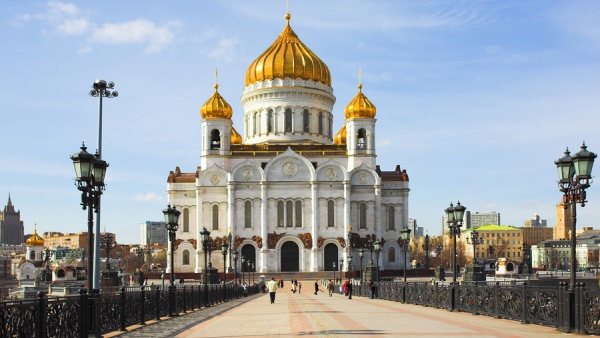
Cathedral of Christ the Saviour

The Cathedral  in front of Kropotkinskaya is Russian main orthodox church.
It is placed on the bank of Moskva-river so that its grand golden dome may be seen from everywhere.

The history of the cathedral deserves special mention.
In 1832 its first project was confirmed by architect Konstantin Ton. It took about 40 years to build this church, which was to honour the war of 1812 between Russia and France.
Unfortunately, it was detonated in 1931. Soon a new swimming-pool appeared at that place.
Only in the 80s the government decided to restore the temple. Five years later the construction was over. Only in 2000 it was hallowed.

The height of the cathedral is 102m, the width - 85 m. It can seat 10,000 people at a time.
What is interesting, is that that the gold cupolas resemble an onion which in their turn look like helmets of great Russian epic heroes - Bogatir.

Tourist may visit the cathedral, order excursions, enjoy a marvellous sight of Moscow from the cathedral's observation deck.

Address: Volkhonka St, 15
It works daily 10.00-17.00. On Fridays 13.00-17.00
Official website: http://www.xxc.ru/english/index.htm


"Bogatiri" by V. Vasnetsov, 1898


Friday, March 22, 2013

Gogolevskiy Boulevard

Kropotkinskaya station resembles the sun with its rays which can lead you to beautiful and exciting places of interest. Directly in front of it is the Cathedral of Christ the Saviour. If we go to the left we'll see the famous Pushkin museum... and if we walk behind the station we'll find ourselves in Gogolevsky Boulevard.

Gogolevsky Boulevard is one of the tenth Boulevards of Moscow which form the famous Garden Ring (Sadovoe Koltso), or Boulevard Ring.
Gogolevsky Boulevard is one of the most beautiful historical places of Moscow. The Boulevard was opened in 1909, but had another name "Prechistinskiy". The name originated from the word "Chistiy" meaning "clean". But in 1924 it was renamed into Gogolevskiy in honour of the famous  Russian writer Nikolay Gogol. At the end of the Boulevard there is a grand monument in his honour.

Another monument is devoted to another Russian writer , Mikhail Sholokhov, and his novel "Tihiy Don" (Still Don).

The Boulevard has a so called three-level structure as once there used to be a river with the banks of different level. That is why the eminence of the boulevard varies.

The architecture of this place is worth seeing. It presents buildings which survived the Great Fire of 1812. More to it, different merchants and famous people like Pushkin or Turgenev of the 19th century.

Nowadays you can be lucky to find there exhibited photos. Sometimes even artists exhibit and sell their works of art there. You can buy anything you like, or just enjoy.

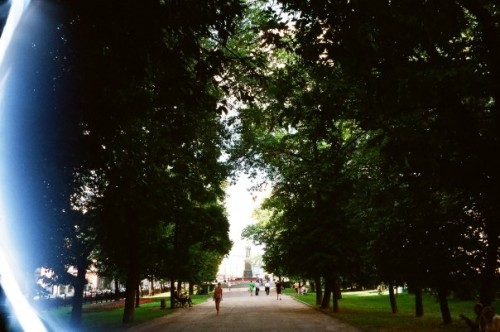
It's especially good there in summer. When it's warm and you can enjoy a beautiful day and trees around you    sitting on a bench...with an ice-cream... )


Monday, March 4, 2013

Moscow Metro. Park Kultury VS Kropotkinskaya

To reach Ostozhenka you may choose any metro station either Park Kultury or Kropotkinskaya.
We've chosen Park Kultury.

Park Kultury was opened in 1935 as a station of the first metro line (Sokolnicheskaya). It was named after the park which is situated near this metro station and has the same name. To find that park you should cross the bridge over Moskva-river. (about that Park we'll speak later))
The metro station has, so to say, two stations - the 1st one is on the red line, the 2nd - on the brown ring (was opened in 1950). (Circle line, or Koltsevaya).

Park Kultury.Circle line.

Red line

Kropotkinskaya station was also opened in 1935 as one of the 1st metro stations, it is next to Park Kultury.
There is also much to explore around it : Gogolevsky Boulevard which goes to Arbat, in front of the metro is the famous Cathedral of Christ the Saviour, near it the Pushkin Museum. 


Kropotkinskaya station. Entrance.


Kropotkinskaya station. Hall.

Sunday, March 3, 2013

Ostozhenka Architecture. Part 2.

Behind the office of the military attache we can see the top of the nunnery, founded in 1584. Though it is sad to say, but once it also used to be a prison and a colony.
Use Korobeynikov lane (Коробейников переулок) or 1st Zachatjevskiy lane (Зачатьевский переулок) to reach it.


This house built in 1907-1909 is famous as a "house with a wine glass". Once belonged to merchant Filatov who used to be addicted to alcohol. When he suddenly gave up drinking and became successful, he decided to build a house with a turned wine glass on its roof as a sign of the protest against drinking.


Ostozhenka is a marvellous place to walk on a sunny day and enjoy different styles of architecture. Turn to its side streets and you'll see yet another world. 


Ostozhenka Architecture. Part 1.

This street is very famous among tourists for its unusual architecture. As is known merchants who lived here tried to make their houses as unique as possible. Fortunately, all these buildings (or most of them) have "survived" and now people of the XXI century have a possibility to see the result of the architects' grand imagination.

1) Moscow State Linguistic University has a long history: was built in the 60-70th of the XVIII for D.Eropkin, one of the famous activists of that time.


2) This house belonged to S. Turgenev's mother. He was one of the greatest Russian writers.
People believe that it was in this house that he wrote his famous novel "Mumu" (the name of the dog which destiny is described there).Now it is a museum.


3) This building  which is now the office of the military attache of Egypt used to be a house for architect Kekushev's wife, was built in 1902-1903.